01
Small Start
02
Proof of Concept
03
Continuous Improvement

Service

We provide system development specializing in prototyping as a service.

Prototyping is a method of running an application that implements the current functions and evolving it while incorporating feedback. The implementation of the application is carried out by our engineers and the client's domain experts, sitting side by side.


We have provided technical consulting and technical support for many SI projects. We participate in SI projects from the early stages, designing and developing Java application architectures and frameworks, and deploying them to application teams. Some projects involve more than 100 people, and the fields are diverse, including communications, finance, transportation, retail, and government agencies.


Based on this track record and experience, we are currently proposing and implementing prototyping. We believe that the following three points are important in order to develop valuable systems cheaply and quickly.

01
Small Start

At the beginning of development, we implement the minimum necessary functions with the minimum number of team members.

By forming a team consisting of members who have the necessary knowledge and skills, the need to create explanatory materials and minutes can be minimized.

Teams are composed of members who understand each other's source code, so we can accurately track each other's level of understanding and progress.

Documentation and progress reports allow you to spend more time and effort on creating better programs.

02
Proof of Concept

No matter how much time and effort you put into creating a system, if it is ineffective or not used, it will all be wasted.

If the functions that embody the system concept make up only 10% of the entire system, then only that 10% should be released first.

Even if the system is never used, it will have saved time and money in developing the remaining 90%.

It is much cheaper and more reliable to actually build and operate something than to accurately predict the future.

03
Continuous Improvement

Developing a system is not the end; it only begins once it is up and running.

We develop it on a small scale, put it into operation, and then repeat the process of analysis, hypothesis, and verification to improve and expand its functions.

To speed up this cycle, we focus on reducing deliverables and automating processes.

Case Studies

Here are some of the projects we have worked on.

Case 01

Retail Company

Participated in a project to migrate a core system built on-premises to AWS, responsible for designing and building the batch architecture. Designed and built an application framework enabling large-scale distributed processing using SQS, Beanstalk, ECS, and Spring Boot. Also implemented high-complexity batch processes and performed performance tuning.

Case 02

Government Agency

Participated in a project to migrate a system built on-premises to the cloud, responsible for exploring and validating application architecture solutions. Proposed and validated solutions that reduced system resources by virtualizing servers and using managed services, and reduced the number of application programs.

Case 03

Financial ResearchCompany

Participated in the development project of a system for algorithmic trading, responsible for designing and building application architecture and DevOps areas. Designed and implemented a domain framework that separates business logic based on financial engineering from an event-driven execution architecture. Also built version control, automated testing, and automated deployment environments. Designed and built an application architecture using AWS Batch that enables large-scale distributed processing in any programming language.

Case 04

Government-relatedCorporation

Participated in a preparation and validation project for core system reconstruction, and worked on batch architecture review and prototype development. Achieved simplification and acceleration of the application by distributing complex long-running batch processes in the existing system using Spring Batch Integration and Kubernetes on AWS.

Case 05

Financial Company

Participated in a project to revamp a sales system for staff, responsible for proposing, designing, and developing the application architecture. Rebuilt the system using SPA and microservices, aiming to improve productivity and shorten the development period while enhancing functionality.

Case 06

R&D-OrientedStartup Company

Participated in a development project for a system that remotely supports on-site workers using wearable devices, responsible for designing and developing the application architecture. Built an SPA using React with AWS Amplify, creating a system to quickly respond to on-site requests.

Product

At Monocrea, we are developing Project Au Lait.

01

Project Au Lait Open in new icon

Monocrea is responsible for the development and operation of Project Au Lait.Project Au Lait is a suite of tools used in system development. Please see the project page for details.

Project Page Open in new iconGit Hub Open in new icon

Company

Company Overview

Company Name
Monocrea Inc.

Established
August 5, 2010

Capital
13,000,000 yen

Location
Taitaku Building 4F, 1-2-10 Higashi-Kanda, Chiyoda-ku, Tokyo 101-0031, Japan

Executive
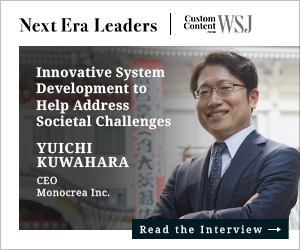
CEO Yuichi Kuwahara

Number of Employees
43

Media Coverage & Features

Recruit

We are always recruiting engineers. If you are interested in working with us, please see the materials below. If you wish to apply or would like to speak with our employees, please contact us below.
Open in new icon

© 2026 Monocrea, Inc.